


About Hawkesbury Pioneers. NSW Australia
The security on this site is set to protect living people. Access is restricted to immediate family.
Updates:
Current
Reviewing and maintaining all records, Adding references where possible.
Aug 2007
St Johns Wilberforce Baptisms. Link
I now have every person from this register included in my tree.
June 2007
Ebenezer Cemetery records. Source "A Colonial Churchyard" Almost everyone is in my tree.
I started building my family tree in April 2005. My cousin had passed on what he had on my side of the family. I started researching my wife's family which can be traced back to early settlement at Sydney Cove and the Hawkesbury Region.
I have received a lot of information from contacts I have made on the net. Thanks to those people for sharing their (our) family history. Whereever possible I have included source references, but some details included are based on assumptions.
A Hawkesbury Connection
Little did I know of my connection to the Hawkesbury region when I bought my
caravan at Ebenezer, on the banks of the Hawkesbury River, it was just a great
place to spend the weekend, and do a bit of water skiing. Fours years after
buying the van I found out that my wife's GGGG Grandmother Elizabeth Ward (nee
Somerville) lived in the area. Elizabeth and her sister Phillis are thought
to be the first twins born in the colony since European settlement. They
were born in 1796, two years after their parents, James and Ann Sommervile,
arrived aboard the "Surprize". James a convict, Ann came free.
First Twins in the Coloney: I have recently discovered twins born in 1794,
Thomas & Elizabeth Graham, to Matthew Lock & Elizabeth Graham.
Elizabeth Sommerville married Michael McGrath ("Boyd" 1809) in 1812. Michael
got on the wrong side of the law, and was sentenced to life, first at
Newcastle, then Port Macquarie. Elizabeth later lived with John Frazier, son
of first fleeters William Frazier ("Charlotte" 1788) and Eleanor Redchester
("Charlotte" 1788). Elizabeth's third partner was James Ward ("Shipley" 1818).
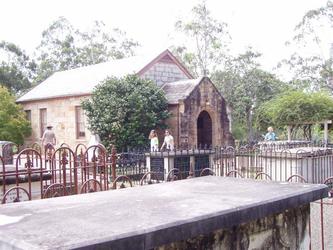
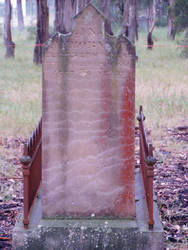
Elizabeth Ward's grave can be found in the historic cemetery, Londonderry
Road Richmond NSW. Information on the Journey of the Surprize, and it's
passengers has come form the book "Settlers And Seditionists" by Michael
Flynn.
The Everingham Family
Two members of the McGrath family married members of the Everingham family. Michael McGrath (b1818), son of Michael & Elizabeth, married Selina Everingham at Richmond, 1859. Michael's son James married Elizabeth Everingham in 1869.
While researching I made contact with a descendant of Matthew Everingham. He
suggested I get a copy of "A Hawkesbury Story" by Valerie Ross. This is
a great book full of Everingham family history, as well as Hawkesbury history.
Boatbuilding on the Hawkesbury
Since the beginning of the Hawkesbury settlement, the main means of
transporting goods and grain had been by the river to and from Sydney, a
necessity with inadequate road links to Sydney and Parramatta. This together
with the need to communicate with neighbours had led to widespread ownership
of small craft. From around 1796, or earlier, as the first farmers at
Hawkesbury set about acquiring rowing vessels and sloops, those among them
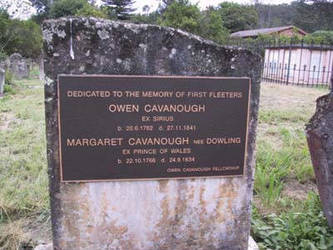
with boat building skills including First Fleeter Owen Cavanough (Sirius
1788), began constructing the small craft for themselves and their
neighbours on their farms. Entrepreneurial Andrew Thompson entered trading,
and by 1806 had carried the local builders into constructing ships up to fifty-
times bigger than the sloops, with John Grono (Free Settler, "Buffalo" 1799)
beginning the "Governor Bligh" for him. She was launched at Green Hills in
March 1807, her 101 tonnes named after the new Governor, as she headed out
bound for the sealing grounds of New Zealand. This began Grono's long
association with, and contribution to, Australia's first staple industry as
from 1818 to 1833 Grono built seven more large vessels at Pitt Town on Canning
Reach, continuing to run his farm and undertake successful sealing voyages. On
completion of the largest of his ships, Grono later acknowledged how he
received a large grant down river, a consideration for having built a vessel
larger by 100 tons than any previously constructed in the colony.
Contemporary commentator, the Presbyterian minister, Dr Lang praised Grono's
vessels as "the largest ... built in New South Wales", making John Grono
arguably the greatest ship builder in the colony. Grono consolidated his
shipbuilding industry expanding his farm and yards on allotments at Canning
Reach and incorporating in 1831 the property of another early boat builder,
John Kelly, with whom Grono had long worked. Grono's son William and other
relatives continued building large trading vessels at Pitt Town on Canning
Reach until late in the nineteenth century, making Canning Reach an
integral part of Pitt Town's historical landscape. Today the Reach is still
rural and contains the archaeological remains of John Grono's ship-building
yards (Grono Park 1), the kitchen of William Grono's house and possibly
remains of William Grono's boat building yards and slipway (Grono Park II and
Thorntons), early tree plantings and an extremely early slab building with a
stone chimney which belonged to Grono relations (Welsted Farm).
Some of the convicts in my tree are:
|

Hawkesbury Pioneers. NSW Australia

